.png)
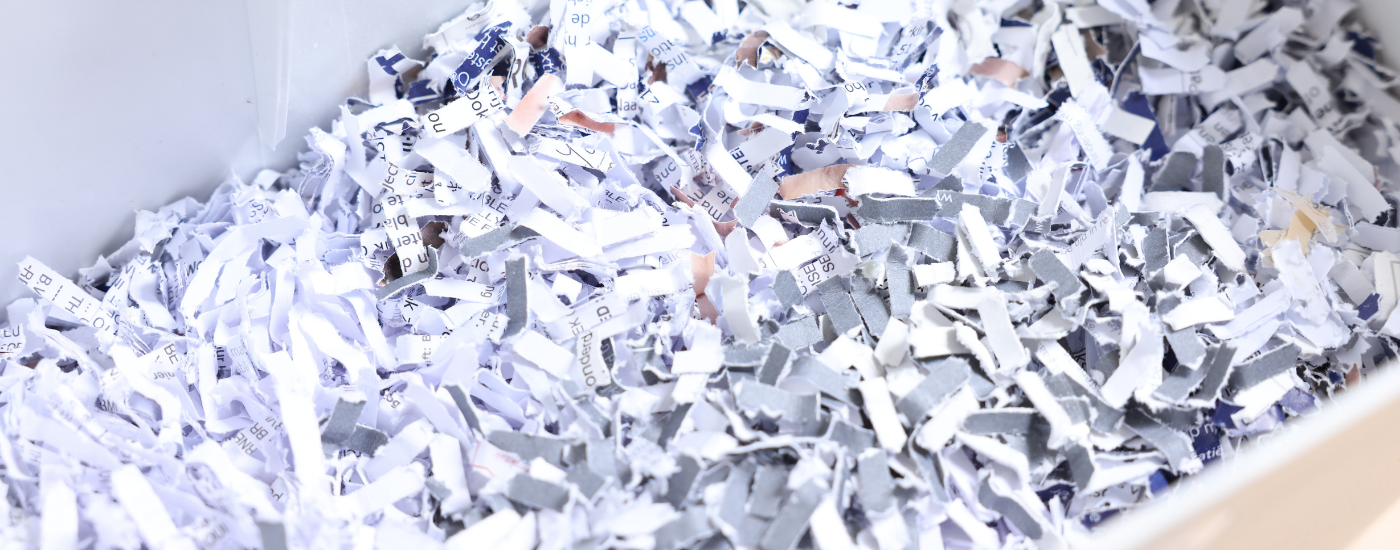
Not all shredded paper is destroyed to the same level.
A document cut into larger fragments may be unreadable at a glance, but the size of the remaining particles affects how difficult reconstruction would be. That is why shredders and professional destruction systems are classified using standardized security levels.
Two levels businesses commonly encounter are P-4 and P-5.
So, what is the difference between P-4 vs. P-5 shredding?
The primary difference is particle size and the resulting level of protection. Under DIN 66399 / ISO/IEC 21964 classifications, P-4 permits paper particles up to 160 mm², while P-5 reduces the maximum particle area to 30 mm².
That means P-5 produces substantially smaller fragments and provides greater resistance to reconstruction.
But a higher number does not automatically mean every organization needs P-5.
The appropriate security level depends on the sensitivity of the information, applicable requirements, contractual obligations, internal security policies, and the consequences of unauthorized disclosure.
Black Ops Destruction provides secure document shredding for businesses and organizations throughout Ohio and the Midwest, with professional destruction procedures designed to protect confidential information from collection through final destruction.
What Are Shredder Security Levels?
Shredder security levels provide a standardized way to classify how thoroughly information-bearing material is destroyed.
DIN 66399 / ISO/IEC 21964 defines seven paper security levels:
- P-1
- P-2
- P-3
- P-4
- P-5
- P-6
- P-7
Higher P-levels generally correspond to smaller destroyed particles and greater resistance to reconstruction.
The important point is that these levels are based on defined technical requirements. They are more meaningful than broad marketing labels such as:
- Standard shredding
- Secure shredding
- High-security shredding
- Micro-cut shredding
Those terms may be useful descriptions, but they do not necessarily tell you the actual standardized particle classification.
What Is P-4 Shredding?
P-4 is a document destruction security level for paper records.
Under DIN 66399 / ISO/IEC 21964, P-4 permits a maximum particle area of 160 mm². For regular particles, the standard also specifies a maximum strip width of 6 mm.
That does not mean every P-4 shredder produces one identical particle size.
Different shredders may create different dimensions while still meeting the P-4 classification, provided the resulting material satisfies the applicable requirements.
What Types of Documents May Be Appropriate for P-4?
Depending on an organization's requirements and policies, P-4 may be considered for confidential business documents such as:
- Employee records
- Customer information
- Financial documents
- Internal reports
- Contracts
- Invoices
- Account information
- Payroll records
- Personnel files
- Vendor information
- Business correspondence
Document category alone, however, should not determine the required destruction level.
Organizations should also consider:
- Applicable laws and regulations
- Contractual requirements
- Client requirements
- Internal security policies
- Risk assessments
- Records-management procedures
- The sensitivity of the information
What Is P-5 Shredding?
P-5 is the next paper security level above P-4.
Under DIN 66399 / ISO/IEC 21964, P-5 permits a maximum particle area of 30 mm², compared with 160 mm² for P-4.
For regular particles, P-5 also uses a narrower maximum strip width.
The smaller fragments provide greater resistance to reconstruction.
When Might P-5 Be Appropriate?
P-5 may be worth considering when an organization handles information requiring a higher level of protection based on:
- Internal information-security policies
- Client requirements
- Contractual requirements
- Risk assessments
- Government requirements
- Industry expectations
- The sensitivity of the information
- The potential consequences of disclosure
Examples can include particularly sensitive:
- Financial records
- Personnel information
- Legal files
- Investigative documents
- Strategic materials
- Proprietary records
- Government-related information
The correct level should be determined by the requirements that actually apply to the information being destroyed.
P-4 vs. P-5 Particle Size
Particle size is the clearest technical difference between these two levels.
P-4: maximum particle area of 160 mm²
P-5: maximum particle area of 30 mm²
The maximum permitted P-5 particle area is therefore substantially smaller than the P-4 maximum.
Smaller fragments generally make reconstruction more difficult.
This is why P-5 represents a higher paper security level within the classification system.
Is P-5 More Secure Than P-4?
Yes.
Within the DIN paper-security classification, P-5 provides a higher level of protection than P-4 because it requires smaller particles.
That does not mean P-4 is inadequate.
The more useful question is:
What level of destruction is appropriate for this information?
Rather than automatically selecting the highest available security level, organizations should match the destruction process to:
- Information sensitivity
- Legal requirements
- Contracts
- Client expectations
- Internal policies
- Risk tolerance
- Operational needs
Is P-4 Secure Enough for Confidential Documents?
P-4 is an established security level designed to provide substantial protection for paper information.
For many organizations, P-4 may be appropriate for confidential business records.
But there is no universal rule stating that every confidential document should be destroyed at P-4.
Before setting a destruction standard, consider:
- What information the document contains
- Who could be affected by disclosure
- Applicable regulations
- Contract terms
- Client requirements
- Internal security policies
- Records-management procedures
If a specific law, contract, client, or government program establishes a destruction requirement, that requirement should guide the decision.
Does HIPAA Require P-4 or P-5 Shredding?
No universal P-4 or P-5 requirement should be assumed from HIPAA alone.
The CDC's HIPAA resources provide background on the Health Insurance Portability and Accountability Act.
Healthcare organizations should evaluate the disposal requirements and safeguards applicable to their circumstances rather than assuming that a particular DIN P-level is automatically required.
The same principle applies more broadly.
A regulation may require secure disposal without prescribing one specific P-level.
Does FACTA Require P-4 or P-5?
FACTA addresses disposal of certain consumer information, but businesses should not automatically translate that requirement into a specific P-level unless the applicable rule actually does so.
It is better to separate two questions:
- What does the law or regulation require?
- What destruction process and security level will the organization use to meet those requirements and its own policies?
That avoids overstating what a regulation specifically mandates.
Is P-5 Required for Medical Records?
Not automatically.
A document being a medical record does not by itself establish that P-5 is universally required.
Healthcare organizations should determine the appropriate destruction process based on:
- Applicable privacy requirements
- Internal policies
- Contractual obligations
- Risk assessments
- Information sensitivity
- Organizational security standards
Some organizations may choose a higher internal standard than others.
Is P-5 Required for Financial Records?
Again, not universally.
Financial records can contain highly sensitive information, including:
- Account numbers
- Social Security numbers
- Payment information
- Customer financial data
- Tax information
- Loan information
- Investment records
But the appropriate destruction method depends on the requirements governing those records.
Organizations should evaluate applicable financial-sector requirements, contracts, internal policies, and risk rather than assuming every financial document automatically requires P-5.
Which Industries May Need Higher-Security Shredding?
Organizations that regularly handle highly sensitive information may have stronger reasons to evaluate higher-security destruction.
Examples include:
- Healthcare organizations
- Financial institutions
- Government agencies
- Defense contractors
- Law firms
- Accounting firms
- Insurance companies
- Educational institutions
- Research organizations
- Technology companies
- Businesses managing proprietary information
Industry alone still does not determine the right P-level.
A small accounting office and a government contractor may both handle confidential information while having very different destruction requirements.
How Should You Choose Between P-4 and P-5?
Start with the information itself.
1. Evaluate Information Sensitivity
Ask what the consequences would be if the information were exposed.
Routine confidential business records may call for a different destruction standard than highly sensitive strategic, financial, legal, investigative, or government material.
2. Review Applicable Requirements
Determine whether any of the following specify a destruction method or security standard:
- Laws
- Regulations
- Contracts
- Client requirements
- Government standards
- Internal policies
3. Consider Your Risk Tolerance
Two organizations handling similar information may adopt different internal standards based on their own risk assessments.
4. Evaluate the Entire Destruction Process
Particle size matters, but secure destruction includes much more than the shredder itself.
Also consider:
- Secure collection
- Employee access
- Chain of custody
- Transportation
- Temporary storage
- Destruction procedures
- Documentation
- Recycling after destruction
A high-security particle size cannot compensate for weak handling procedures before the documents reach the shredder.
Security Level Is Only One Part of Secure Document Destruction
Businesses sometimes focus entirely on shred size.
That can overlook the broader security process.
Consider confidential employee files waiting for destruction.
Even if they will eventually be shredded to a very small particle size, they may still be vulnerable if they are:
- Left unattended
- Stored in an unsecured hallway
- Transported without controls
- Accessible to unauthorized personnel
- Placed into ordinary recycling
- Handled without accountability
Professional information destruction should protect records throughout the process.
Black Ops Destruction's secure document destruction services can include:
- Secure collection
- Controlled chain-of-custody procedures
- Background-checked personnel
- GPS-tracked vehicles
- Secure facilities
- Video monitoring
- Certificates of Destruction
- Responsible recycling after destruction
The goal is to protect confidential information from the moment it enters the destruction process through final processing.
P-4 vs. P-5 vs. P-6 vs. P-7
P-4 and P-5 are only two levels within the seven-level paper classification.
As the level increases, the maximum permitted particle size becomes progressively smaller.
Under DIN 66399 / ISO/IEC 21964:
- P-4: up to 160 mm²
- P-5: up to 30 mm²
- P-6: up to 10 mm²
- P-7: up to 5 mm²
P-6 and P-7 therefore impose more stringent particle requirements than P-5.
That still does not mean every organization should automatically select P-7.
The appropriate level should match the actual security requirements of the information.
What About P-1, P-2, and P-3?
Lower P-levels allow larger fragments than P-4 through P-7.
For example:
- P-2: maximum particle area of 800 mm²
- P-3: maximum particle area of 320 mm²
- P-4: maximum particle area of 160 mm²
As the P-level increases, allowable particle size decreases.
If your organization needs to evaluate the full P-1 through P-7 system, make sure you compare the applicable technical requirements rather than relying only on broad labels such as strip-cut, cross-cut, or micro-cut.
On-Site vs. Off-Site Shredding and Security Levels
Where destruction occurs is separate from the P-level achieved.
On-Site Shredding
Mobile on-site shredding allows documents to be destroyed at the customer's location.
Organizations may prefer this when internal policy or operational preference calls for destruction before materials leave the property.
Off-Site Shredding
Secure off-site shredding involves collecting confidential documents and transporting them under controlled procedures to a destruction facility.
The distinction is straightforward:
On-site vs. off-site describes where destruction happens.
P-4 vs. P-5 describes the security characteristics of the destroyed paper.
They answer different questions.
What Should You Ask a Shredding Company About Security Levels?
If a specific P-level matters to your organization, verify it directly.
Ask:
- What security level does your destruction process achieve?
- What particle specifications apply?
- Is that security level appropriate for our requirements?
- How are documents secured before destruction?
- Who handles the material?
- How is chain of custody maintained?
- Is destruction performed on-site or off-site?
- What documentation is provided?
- What happens to the paper after destruction?
- What relevant industry certifications does the provider hold?
These questions help you evaluate the complete destruction process rather than selecting a company based on a single security claim.
Why Professional Shredding Can Be Better Than an Office Shredder
An office shredder may carry a P-4 or P-5 rating, but the equipment rating is only one part of an organization's document-destruction process.
Businesses also have to manage:
- Employee time
- Shredder capacity
- Paper jams
- Maintenance
- Secure document collection
- Disposal of shredded material
- Consistent procedures
- Documentation
- Large records purges
A professional shredding program centralizes that process.
Employees can place confidential paperwork into designated secure collection containers, and authorized material can be handled through an established destruction workflow.
For organizations producing significant volumes of confidential records, this can be more practical than expecting employees to manually shred documents throughout the workday.
Frequently Asked Questions About P-4 vs. P-5 Shredding
What is the main difference between P-4 and P-5 shredding?
The primary difference is maximum permitted particle size. P-4 permits paper particles up to 160 mm², while P-5 permits particles up to 30 mm². P-5 therefore provides a higher paper security level and greater resistance to reconstruction.
Is P-5 better than P-4?
P-5 provides a higher level of security because it requires substantially smaller particles. Whether it is more appropriate for your organization depends on your information, requirements, policies, and risk profile.
Is P-4 considered secure shredding?
Yes. P-4 is an established paper security classification. Whether it is the appropriate level for a specific record depends on the requirements governing that information.
What size is P-4 shredding?
P-4 permits a maximum particle area of 160 mm² under DIN 66399 / ISO/IEC 21964. Actual particle dimensions can vary as long as the applicable P-4 requirements are met.
What size is P-5 shredding?
P-5 permits a maximum particle area of 30 mm² under the applicable classification.
Does HIPAA require P-5 shredding?
HIPAA should not be described as universally requiring P-5 for every paper record. Covered organizations should evaluate applicable disposal requirements, safeguards, risks, and internal policies.
Is P-5 required for financial documents?
Not automatically. Organizations should determine the appropriate destruction level based on applicable financial requirements, contracts, internal policies, and information sensitivity.
Is P-5 micro-cut?
P-5 shredders are often marketed as micro-cut equipment because they produce very small fragments. However, the standardized P-5 classification is based on meeting defined particle requirements, not the marketing term itself.
Is P-5 enough for classified information?
Do not assume so. Organizations handling classified, defense, government, or specially controlled information should follow the specific destruction standards and approved equipment requirements applicable to that material.
Does higher-security shredding eliminate the need for chain of custody?
No. Particle size protects information after destruction. Chain-of-custody procedures help protect the documents before destruction. Both can be important parts of a secure information-destruction program.
Why Businesses Choose Black Ops Destruction
Black Ops Destruction provides professional document destruction for organizations that need secure, accountable handling of confidential information.
Our capabilities include:
- NAID AAA Certified information destruction
- Mobile on-site shredding
- Secure off-site shredding
- Recurring shredding programs
- One-time document purges
- Secure collection containers
- Controlled chain-of-custody procedures
- Certificates of Destruction
- Background-checked personnel
- GPS-tracked vehicles
- Responsible paper recycling
- Hard drive and media destruction
- Electronics recycling
As a veteran-led, Service-Disabled Veteran-Owned Small Business with more than 30 years of combined experience, Black Ops Destruction helps organizations manage confidential records through secure destruction processes designed around their operational and security requirements.
Choose the Security Level That Matches the Information
The difference between P-4 and P-5 shredding comes down primarily to particle size and the resulting resistance to reconstruction.
P-4 permits particles up to 160 mm² and provides an established level of protection for confidential paper records.
P-5 reduces the maximum particle area to 30 mm², creating a higher security classification.
But selecting a shredding level should not become a race to the highest number.
Instead, ask:
What information are we destroying?
What requirements apply to it?
What would the consequences of disclosure be?
What destruction standard does our organization actually need?
Then evaluate the entire process, including secure collection, chain of custody, transportation, destruction, documentation, and recycling.
Black Ops Destruction provides secure document shredding throughout Ohio and the Midwest, with mobile on-site and secure off-site options for businesses and organizations managing confidential records.
Call: 330-888-5410
Email: mmarzullo@blackopsdestruction.com
Contact: Request a Quote
.png)